The Buyback
The 1981 Buyback.
As a Harley owner and/or enthusiast who is a friend of North Coast V-Twins, we’re pretty sure that you’ve learned a little of Harley-Davidson’s amazing history… so you’ve heard of “the buyback”. Today for our Sunday Run we’ll flesh out a little information and have a brief look at an intricate moment which saved the Motor Company.
Actually, in the 123-year history of H-DMC there are several “saved the company” moments, and the buyback is the second of a matched-set – 1) AMF Corporation bought H-D, and 2) AMF Corporation sold H-D - both at times of financial trouble. In the late 1960s Harley-Davidson was struggling, in fact close to liquidation, and a sale to AMF was arranged and completed in 1969. The deal was brought about in order to save Harley-Davidson from closure. Despite the later poor reputation of the motorcycles built in the AMF era, there is no doubt that without AMF buying the brand, there would be no H-D today.
AMF injected the cash needed at the time, and kept the Harley name going through those lean years and all the way through through the 1970s. There were rumblings of discontent concerning the workmanship and reliability of the AMF-era Harleys among some owners of the machines (from some of our NCV-T associate’s personal experience, this was a valid criticism), and it was commonly believed that the overall quality and image of the machines and the brand dipped lower than ever before. The 1970s also saw intense competition in heavyweight motorcycles, and the sales and innovations from non-American manufacturers were intense. New models like the Honda 750 Four (especially), the Yamaha 650, Ducati 900, Triumph 650, Kawasaki Mach III and 900-Four were providing real competition in performance and price for the Harleys being produced under the AMF badge.
Yet, in the USA Harley-Davidson remained the top-selling brand of heavyweight motorcycles.
But a huge Corporate like AMF wanted greater return on investment, and lesser costs in new product development, so in late 1980, there was talk of AMF selling the company again. In order to prevent a sale to perhaps “just another big Corporation”, thirteen Harley-Davidson executives came together, raised and invested the money to purchase the company back from AMF. The sale was announced by AMF in February 1981, and the completed USD$80M sale of the company occurred on June 16, 1981.
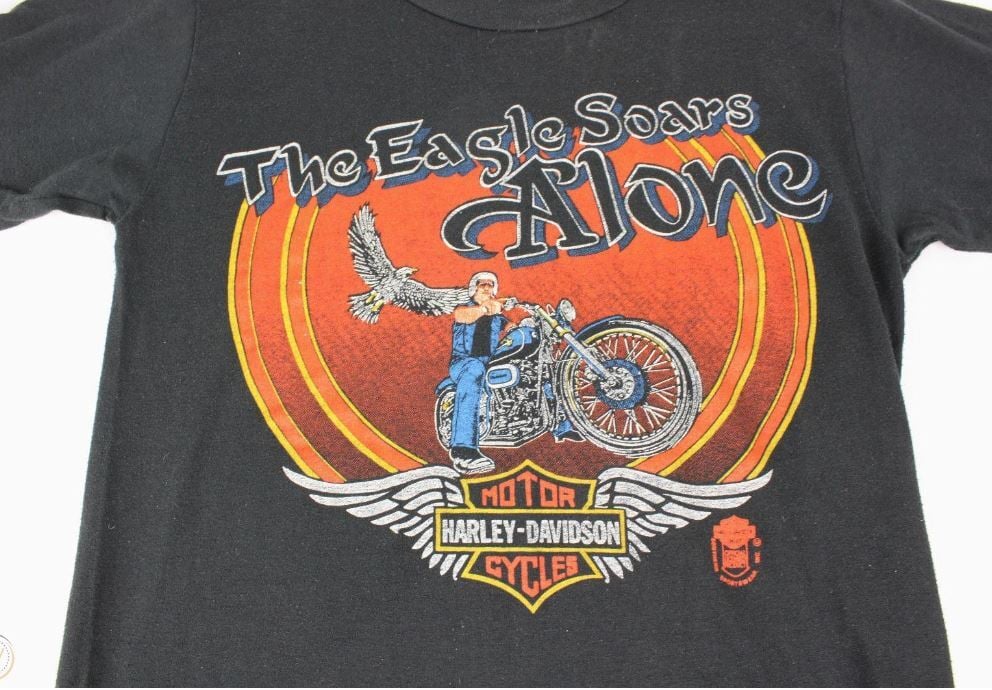
The Factory marketing immediately following the buyback was under the brilliant tag “The Eagle Soars Alone.” (See the pics for merchandise from the time, including the famous shot of Willie G Davidson with “AMF” crossed-out on his tee!)
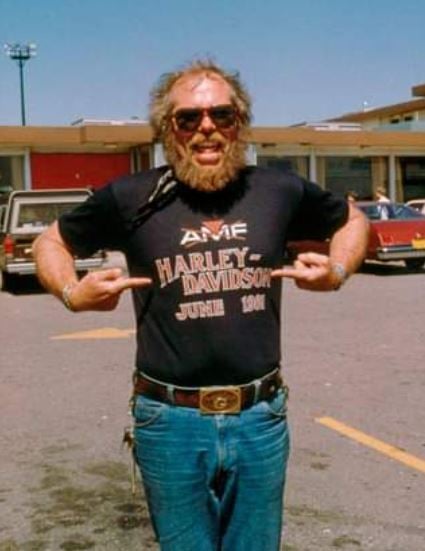 It’s beyond doubt that the group of executives were not just looking for a return on their own (personal) massive investments, but were also driven by passion and a true belief in the H-D brand. The ‘face’ of the buyback was Willie G Davidson himself, and the driving force and organizational genius was AMF's vice president, Vaughn Beals. Beals had overseen the H-D division since 1976, but left AMF and headed-up the H-D executives buying group.
In the Motor Company’s 123-year history, Vaughn Beals needs to be regarded as a leader on-par with the original four-founders.
Was the buyback successful? Explosively so… YES! Instead of trying to emulate its competition, Harley-Davidson focused on building motorcycles that looked similar to its older models before the AMF era, with new improvements to make them more appealing in the current market.
The 13 executives had cards up their sleeves, and in 1984 dropped a pair of aces on the table and released a motorcycle which would change the riding world… the Softail, powered by the new Evolution V-Twin engine.
In that bike were innovations which allowed the broader public access to effortless Harley-ownership, and which would change the world’s perception of Harley-Davidson … the Evolution 1340 V-Twin was powerful and oil-tight, and belt-drive was clean and reliable, and electric start made it easier.
From that 1984 Softail came Willie G’s styling-genius models… Heritage, Springer, Fat Boy, Night Train, and more. The demand, the growth, and the cachet of the Softail model range grew without a break for the next 30-plus years.
Side-by-side with the bikes was the vision and attention paid to honouring, and strengthening, the H-D legend and brand culture. HOG was introduced just two years after the buyback, allowing the always-passionate H-D owners to feel more a part of the huge, world-wide, one big family.
Dealers globally were encouraged (pretty strongly) to transform into Designer Stores… impeccable, beautiful, well-lit and above all welcoming, these were motorcycle stores full of stunning bikes, riding gear, casual apparel, collectibles and homeware. No more chains, throttle cables and brake discs hanging on pegboard walls, and women felt welcome and more comfortable than ever in a bike shop!
You’ve seen the current designs and stylings of Designer Stores every time you enter and are welcomed into our V-Twins Harley dealership today.
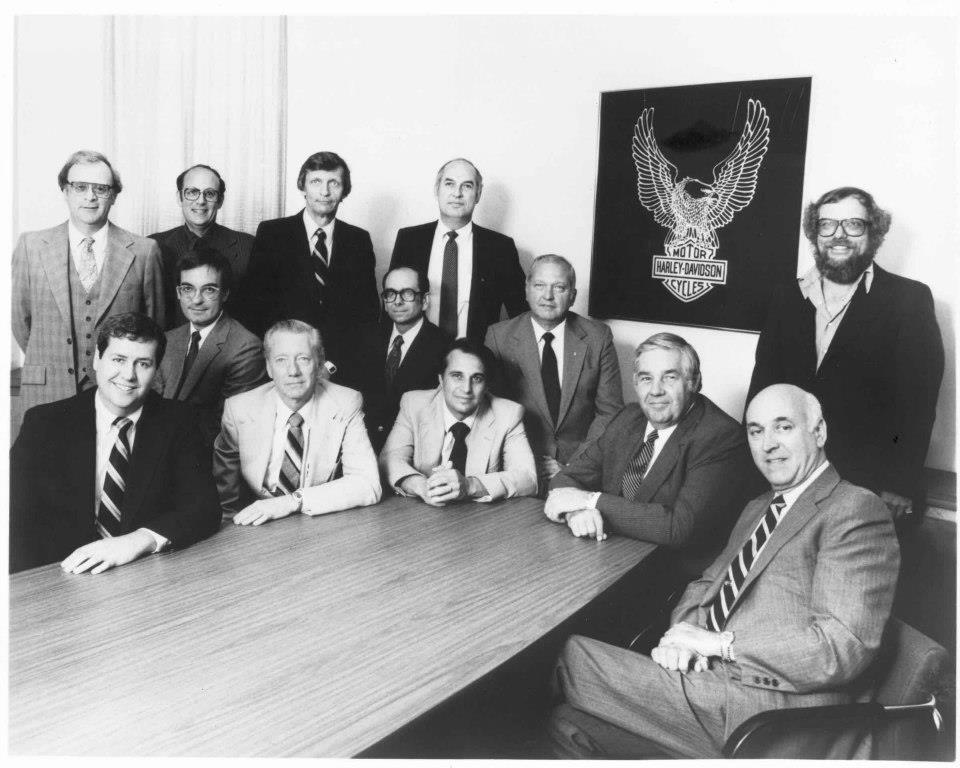
There’s a photo here today showing the 13 Executives: Left to right standing: John Hamilton, Dr. Jeffrey Bleustein, Kurt Woerpel, Christopher Sartalis, and Willie G. Davidson. Left to right, seated: James Peterson, Timothy Hoelter, David Lickerman, Peter Profumo, David Caruso, Ralph Swenson, Charles Thompson, and Vaughn Beals Jr.
Apart from the rightful styling fame of Willie G, Bleustein, Thompson, and Beals all became CEOs of the Company, and David Lickerman is the executive who visited Australia and New Zealand in the 1980s, helping to create the H-D brand presence we have here today.
So when you crack a beer after your ride today, tip a little thank-you to these 13 risk-takers who financed and personally guaranteed the buyback. Almost certainly, without them we wouldn’t be riding Harley-Davidson Motorcycles today.
Cheers to you all, and have a great Sunday!